Manual vs Hydraulic Torque Tools for Heavy Equipment
Manual vs Hydraulic Torque Tools for Heavy Equipment: Performance and Selection Guide
Torque tools are essential in heavy equipment assembly and maintenance.
Choosing between Manual Torque Wrenches and hydraulic torque tools directly affects efficiency, accuracy, and safety.
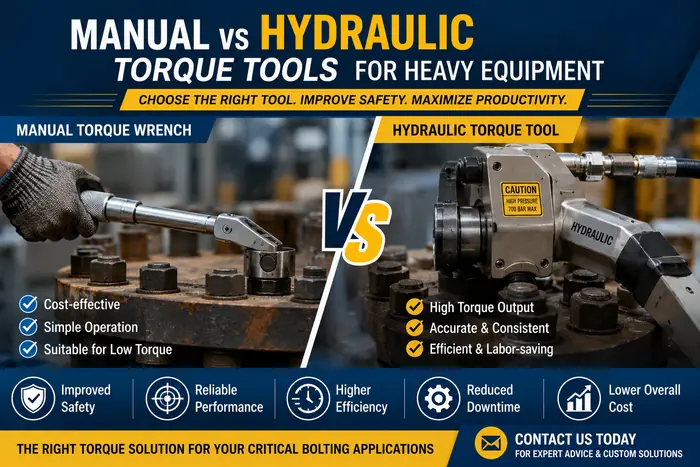
1. Overview of Manual and Hydraulic Torque Tools
1.1 Manual Torque Tools
Manual torque wrenches rely on human force to tighten bolts.
They are simple in structure and easy to operate.
These tools are commonly used in low torque applications and light maintenance work.
1.2 Hydraulic Torque Tools
Hydraulic torque tools use hydraulic pressure to deliver high and precise torque output.
They are widely used in industries such as mining, construction, oil and gas, and wind energy.
These tools ensure consistent performance under demanding conditions.
2. Key Differences Between Manual and Hydraulic Torque Tools
2.1 Torque Output Capability
Manual tools are limited by operator strength.
They are not suitable for high torque requirements.
Hydraulic torque tools can deliver extremely high torque with minimal effort.
This makes them ideal for large bolts and heavy equipment.
2.2 Accuracy and Consistency
Manual torque wrenches depend on user skill and experience.
Inconsistent operation may lead to uneven bolt tightening.
Hydraulic tools provide stable and repeatable torque output.
This improves joint reliability and reduces failure risk.
2.3 Efficiency and Labor Cost
Manual tools require more time and physical effort.
They are less efficient in large-scale operations.
Hydraulic torque tools significantly increase productivity.
They reduce labor intensity and shorten maintenance time.
2.4 Safety Considerations
Manual tools may cause operator fatigue and injury under high loads.
Hydraulic torque tools are designed with controlled force output.
This reduces the risk of accidents and improves workplace safety.
3. Application Scenarios in Heavy Equipment
Manual torque tools are suitable for small equipment and routine maintenance.
They are often used where torque requirements are low.
Hydraulic torque tools are preferred in heavy industries.
They are widely applied in flange bolting, structural assembly, and large machinery installation.
For critical operations, hydraulic solutions ensure reliability and precision.
4. How to Choose the Right Torque Tool
Evaluate the required torque range and working conditions.
Consider the frequency of use and project scale.
For high-load and continuous operations, hydraulic torque tools are the better choice.
For occasional use and lower torque, manual tools remain cost-effective.
Partnering with a professional torque tool manufacturer ensures access to high-quality equipment and technical support.
Reliable suppliers provide customized solutions based on your application needs.
5. Increase Efficiency with the Right Equipment
Using the correct torque tool improves productivity and reduces downtime.
Hydraulic torque tools deliver superior performance in demanding environments.
They are a valuable investment for companies seeking long-term operational efficiency.
Contact us today to get expert advice and competitive pricing on industrial torque tools.
Submit your inquiry now and receive tailored solutions for your heavy equipment applications.
Why Choose Axion™ as Your Supplier?
With 20 years of industry experience, Axion is a leading Chinese manufacturer of high-quality tools, offering competitive pricing and excellent customer service.We pride ourselves on exceptional quality control, extensive experience, and comprehensive after-sales service.