Safe Flange Spreader Operation and Maintenance Best Practices for Industrial Sites
Mastering Safe and Efficient Flange Separation: A Technical Approach to Hydraulic and Mechanical Spreader Tools
Correct flange spreader operation prevents equipment damage and saves maintenance hours.
This article details proven procedures for using both hydraulic and mechanical spreaders.
Follow these guidelines to achieve controlled separation every time.
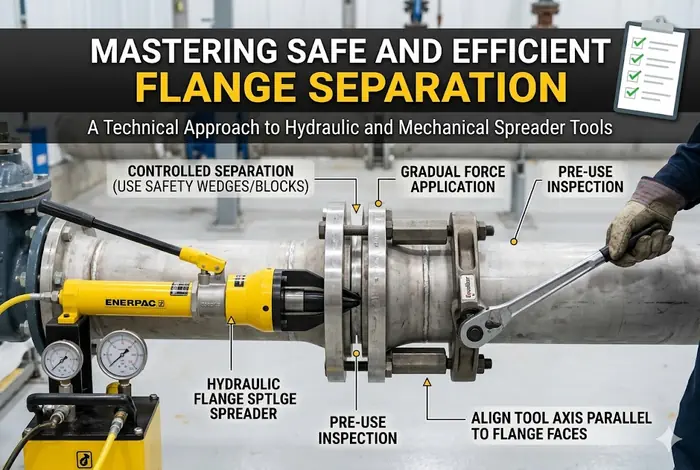
Pre‑Use Inspection Checklist for Flange Spreader Tools
Inspect every component before applying force.
Neglecting this step leads to tool slippage and sudden flange release.
Visual Examination of Wedges and Cylinders
Check wedge tips for deformation, cracks, or excessive wear.
Inspect hydraulic cylinder rods for scratches, pitting, or fluid leaks.
Verify that stepped blocks are not bent and fit the bolt hole diameter precisely.
Function Test of Mechanical Ratchet Mechanisms
Operate the ratchet handle through full range without load.
Listen for clicking or grinding sounds indicating internal damage.
Ensure the release lever moves freely and returns to locked position.
Step‑by‑Step Safe Spreading Procedure
Follow these actions sequentially to minimise risk.
Positioning and Alignment
Insert the spreader tip into the gap between flanges or into two adjacent bolt holes.
For bolt‑hole insertion, select the stepped block that matches the hole diameter.
Align the tool axis parallel to the flange faces to avoid cocking.
Gradual Force Application
For hydraulic spreaders: Pump slowly until initial contact is felt. Pause and recheck alignment. Increase pressure in 10% increments. Stop immediately if the flange shows uneven lifting.
For mechanical spreaders: Turn the ratchet handle with steady, short strokes. Do not use extension bars for extra leverage – that indicates insufficient tool capacity.
Maintaining Control During Separation
Insert temporary wedges or retainer blocks once the gap reaches 10‑15 mm.
This prevents sudden closure if the spreader loses pressure or slips.
Release the spreader force gradually after the gasket or alignment work is complete.
Common Mistakes That Damage Flange Faces or Tools
Understanding typical errors helps operators avoid costly repairs.
Applying Force Without Complete Insertion
If the wedge tip is not fully seated, the tool will eject violently when pressurised.
Exceeding Rated Tonnage
Forcing a 20‑ton spreader to separate a corroded 36‑inch flange will bend the tool body or crack the flange.
Ignoring Bolt Hole Condition
Burrs or rust inside bolt holes prevent proper block seating. Clean holes before tool insertion.
Post‑Operation Maintenance for Long Tool Life
Clean and lubricate the flange spreader after every job.
Store in a dry, labelled case away from welding sparks and chemicals.
Hydraulic Spreader Maintenance
Check hydraulic oil level and contamination every 50 operating hours.
Replace worn seals immediately – leaks reduce force and attract dirt.
Bleed air from the system if the pump feels spongy.
Mechanical Spreader Maintenance
Apply anti‑seize lubricant to ratchet gears and pivot points monthly.
Inspect wedge retaining pins for elongation or shear.
Replace any deformed stepped block before next use.
When to Replace Rather Than Repair a Flange Spreader
Some damage cannot be safely repaired.
Retire the tool immediately if any of these conditions appear.
• Wedge tip has lost more than 10% of original thickness.
• Hydraulic cylinder shows external leakage after seal replacement.
• Ratchet mechanism skips teeth under moderate load.
• Frame or handle exhibits visible bending.
Investing in a high‑quality flange spreader from a reputable supplier reduces long‑term maintenance costs.
Always keep a spare spreader on site for critical infrastructure to avoid unplanned downtime.
Why Choose Axion™ as Your Supplier?
With 20 years of industry experience, Axion is a leading Chinese manufacturer of high-quality tools, offering competitive pricing and excellent customer service.We pride ourselves on exceptional quality control, extensive experience, and comprehensive after-sales service.